
Loss & Damage refers to the destructive impacts that climate change is having today, in spite of mitigation and adaptation efforts. While negotiators and policymakers work to avoid the worst-case scenarios of climate change, a certain amount of destruction caused by humanity’s burning of fossil fuels is already ‘locked in’. For example, rising sea levels have already caused infrastructure damage to the Marshall Islands.
Loss & Damage falls into two categories: economic and non-economic. It also refers to a movement led by climate vulnerable nations who have contributed the least to global warming to get the biggest emitters to pay for damages caused by climate change. In 2022 at COP27 in Sharm el-Sheikh, countries agreed to establish a Loss and Damage Fund (LDF) to help developing and low-income nations recover from climate-change induced destruction. The LDF was operationalized in 2023 at COP28 in Dubai. As of December 2023, wealthy and developed nations pledged a combined $700 million to the LDF.
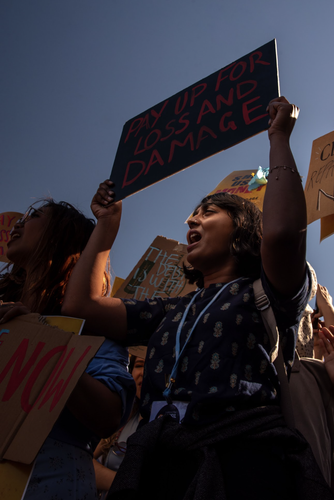
Disha Ravi and Mitzi Jonelle Tan participate in COP27’s Global Day of Action, civil society demanded polluters “pay up for Loss and Damage” and called for a finance facility to support frontline communities. Sharm El-Sheikh, Egypt, 2022.
Photography By Pamela EA
RESEARCH
Interviews by Pamela EA
Text by Megan Snaith
Video Editing by Molly Nemer
Editing by Youth4Capacity
November 8, 2024
Research by Micheala Chan
Fact-checking by Hailey Basiouny
May 19, 2025
“Loss and Damage” (capitalised) refers to the policies and mechanisms designed to respond to climate‑related harms, while “loss and damage” (lowercase) describes the actual impacts themselves. “Loss” captures what is gone forever (lives, species, cultural heritage, ecosystems, territories and livelihoods) whereas “damage” refers to harms that can be repaired or restored, such as impacts on health, soils, homes, infrastructure, schools and businesses.
Loss and damage is also divided into “economic” and “non‑economic” categories. Economic loss and damage includes impacts that can be measured in monetary terms, such as destroyed property, lost crops or livestock, reduced productivity, or damage to infrastructure like roads and power systems. Non‑economic loss and damage covers everything that cannot be priced, including cultural, social, ecological and emotional harms.(1)
Non‑economic loss and damage (NELD) refers to climate impacts that cannot be easily quantified, such as cultural loss, trauma, or ecosystem decline. Although it is recognised in the Paris Agreement and UNFCCC processes, there is still no agreed way to define or assess it. Competing evaluation approaches and its frequent omission from national adaptation plans make NELD difficult to integrate into policy or cost-benefit analyses, leaving UN‑level discussions stalled by the lack of a shared framework.
Loss and Damage must be treated as a central pillar of climate finance because climate‑vulnerable countries face disproportionate, often non‑economic harms rooted in historical and structural inequalities. The Vulnerable 20 (V20) economies alone lost an estimated US$525 billion between 2000–2019, and addressing these impacts requires recognising the enduring effects of colonial and capitalist systems while ensuring that finance mechanisms deliver justice, accountability and support at the scale required.
Loss and Damage has evolved through decades of stalled negotiations, moving from early rejection in the 1990s to the gradual creation of formal mechanisms: first the Warsaw International Mechanism in 2013, then Article 8 of the Paris Agreement, and finally the establishment and operationalisation of a dedicated fund at COP27–28. Yet debates over responsibility, liability and funding scale continue to slow progress, making community‑shaped approaches and diverse financing sources essential as losses already exceed what mitigation and adaptation can prevent.
Loss and Damage is a growing concern for the Pacific, especially as island communities are particularly vulnerable to unavoidable impacts of climate change, making it inextricably linked to climate justice. Small Island Developing States contribute just 0.6% of global emissions yet face escalating threats such as sea‑level rise, extreme weather, and severe coastal erosion. This is visible, for example, in Kosrae (Federated States of Micronesia), where most households lie below 4 m elevation, experience repeated storm damage, and confront a worsening feedback loop of mangrove loss and shoreline retreat that leaves communities with adaptation measures that are often insufficient and requiring policies such as relocation, coastal restoration and strengthened infrastructure.
The 2022 IPCC Working Group II report distinguishes the political debate on “Loss and Damage” under the UNFCCC from the broader “losses and damages” already occurring worldwide. It concludes that human‑driven climate change is causing widespread harm that falls unevenly on vulnerable regions, cannot be fully prevented through adaptation, will intensify with further warming, and is not adequately addressed by current financial and institutional arrangements (even if warming is limited to 1.5°C).
Created in 2013, the Warsaw International Mechanism has become the central UNFCCC body for advancing work on loss and damage by improving knowledge on risk management, strengthening coordination across stakeholders, and enhancing action and support for vulnerable countries. It has helped develop practical approaches, identify major support gaps, engage diverse communities of practice, and drive the global agenda toward in‑country technical assistance and finance, and it continues to act as a key platform for sharing good practices and deepening international cooperation.
Progress has been made on Loss and Damage funding at recent COPs. At COP27 (2022), countries agreed to establish new funding arrangements for loss and damage. The following year, at COP28, countries agreed to the operationalisation of the loss and damage fund. The World Bank will host the Fund secretariat and provide trustee services for the Fund.
The most contentious issue at COP29 was whether Loss and Damage should be included in the New Collective Quantified Goal on Climate Finance, with developing countries pushing for its inclusion and developed countries resisting. Parties ultimately agreed that the NCQG will not cover Loss and Damage, and with only limited progress made across related negotiations, the issue was deferred yet again.
Frontline experiences of climate‑related loss and damage are still poorly documented. The Asia-Pacific Network for Global Change Research developed a community‑led assessment handbook that offers a structured way for communities to record their losses, plan for future risks, and generate evidence that governments can use within Paris Agreement processes to seek financial and technical support.
The Guna people of Gardi Sugdub in Panama are facing the loss of their island homeland as sea‑level rise, coastal erosion, and overcrowding make the island increasingly uninhabitable, forcing the community (who are deeply tied to the islands culturally and historically) to relocate to a mainland settlement that offers safety but disrupts tradition, strains services, and alters daily life. The 2024 move of around 1,000 residents marks Panama’s first climate‑driven relocation and is seen as an emerging model for other communities confronting similar climate‑forced displacement. (13)
The Loss & Damage Coalition. “What is Loss and Damage?” The Loss & Damage Coalition, n.d.
Padin-Dujon, Alejandra. “What Is ‘Non-Economic’ Loss and Damage (NELD)?” Grantham Research Institute on Climate Change and the Environment, June 20, 2023.
Sharma, Sindra, Teo Ormond-Skeaping, and Leia Achampong. “Loss and Damage as the Third Pillar of Climate Action: Delivering a Loss and Damage Sub Goal under the NCQG at COP29.” Loss and Damage Collaboration, 2024.
Bhandari, Preety, Nate Warszawski, Deirdre Cogan, and Rhys Gerholdt. “What Is ‘Loss and Damage’ from Climate Change? 6 Key Questions, Answered.” World Resources Institute, November 4, 2024.
Pacific Community. “What Are Loss and Damage & Climate Justice?” YouTube, June 22, 2023.
Monnereau, I. and Abraham, S. (2013). Loss and damage from coastal erosion in Kosrae, The Federated States of Micronesia. Loss and Damage in Vulnerable Countries Initiative, case study report. Bonn: United Nations University Institute for Environment and Human Security.
Thomas, Adelle. “What does the IPCC say on losses and damages?” Climate Analytics, June 2, 2022.
UNFCCC. “Warsaw International Mechanism for Loss and Damage Associated with Climate Change Impacts.” UNFCCC, n.d.
World Bank. “The Fund to Address Loss and Damage.” World Bank, n.d.
Carbon Brief. “COP29: Key Outcomes Agreed at the UN Climate Talks in Baku.” Carbon Brief, November 24, 2024.
Singh, Harjeet, and Sindra Sharma. “A People-Centred Approach to Assess and Address Impacts of Climate Change-Induced Loss and Damage.” In Linking Climate Change Adaptation, Disaster Risk Reduction, and Loss & Damage , edited by Vositha Wijenayake, Linda Anne Stevenson, Akio Takemoto, Amit Ranjan, Dennis Mombauer, and Nafesa Ismail, 29–45. Palgrave Macmillan Singapore, 2024.
Salido, Adri. “Gardi Sugdub: The Americas’ disappearing island.” BBC, January 6, 2024.
Cañada, Gonzalo, and Agustina Latourrette. “Climate Change: The Panama community that fled its drowning island.” BBC, February 8, 2025.
RESOURCES FOR FURTHER LEARNING